Fast Code vs Sustainable Systems: The Trade-Off Most Developers Ignore
Prasad Mahure
Full Stack Engineer · Pune, India · Building SaaS, real-time systems, and AI-powered products.
Fast Code vs Sustainable Systems: The Trade-Off Most Developers Ignore
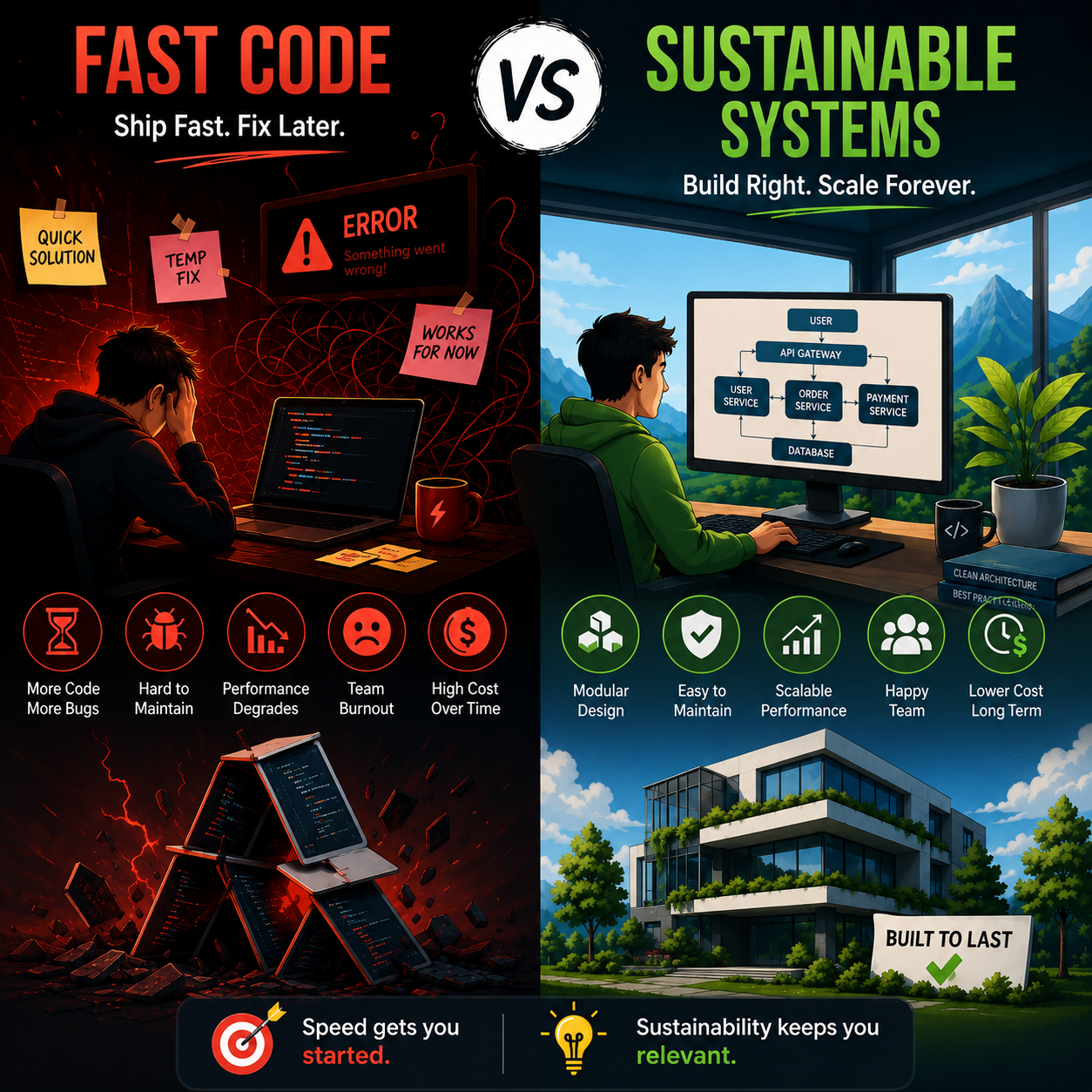
In software engineering, speed is often celebrated. Teams are encouraged to ship features quickly, fix issues later, and maintain a rapid development cycle to stay competitive. During the early stages of a product, this approach can appear highly effective. Features are delivered on time, customers are satisfied, and growth feels effortless. However, as the application evolves and the codebase expands, the hidden costs of prioritizing speed over sustainability begin to surface.
A system that was once simple and manageable gradually becomes more difficult to maintain. New features require significantly more effort to implement, minor bugs take hours to investigate, and deployments become increasingly stressful. Development teams often find themselves spending more time managing technical complexity than creating value for users. This shift is rarely caused by growth alone; it is often the result of architectural decisions that prioritized immediate delivery without considering long-term maintainability.
The distinction between fast code and sustainable systems is important. Fast code is designed to solve today's problem as quickly as possible. Sustainable systems, on the other hand, are designed to continue performing effectively as requirements, traffic, and team structures evolve. While both approaches may produce working software, only one is capable of supporting long-term growth without accumulating significant technical debt.
Sustainable systems are built with deliberate engineering practices. They emphasize modular architecture, reusable components, predictable data flow, clear separation of concerns, maintainable database structures, and scalability considerations from the beginning. These principles may require additional effort during development, but they significantly reduce future complexity and make systems easier to extend and maintain.
One of the most common misconceptions in software development is the belief that software will remain small. In reality, successful products rarely stay in their original form. New business requirements emerge, user bases grow, integrations become necessary, and teams expand. Temporary workarounds that seemed reasonable during initial development often become critical dependencies in production environments. As these shortcuts accumulate, they create a foundation that becomes increasingly difficult to modify without introducing risk.
Ironically, many engineering slowdowns originate from decisions that were initially made to increase development speed. A shortcut taken to meet a deadline can create months of additional work in the future. Poorly structured modules, tightly coupled services, and inadequate database designs often become the primary obstacles to innovation as products mature.
Building sustainable systems does not mean pursuing perfection or over-engineering every solution. It means making thoughtful decisions that minimize future friction and allow software to evolve gracefully. The objective is not to predict every future requirement but to create an architecture that can adapt to change without requiring constant rework.
The most successful software systems are not necessarily those built the fastest. They are the systems that continue to function reliably as they scale, support new features without major disruption, and remain maintainable despite years of growth and change. In professional software engineering, speed is important, but sustainability is what determines whether a product can survive and thrive over the long term.
Building software that works today is relatively straightforward. Building software that remains reliable through years of feature requests, scaling challenges, changing business requirements, and evolving development teams is a far greater challenge. That is where true engineering begins.
// related_posts
You might also like

The Most Dangerous Line in Software Engineering: “We’ll Optimize It Later.
Scalability isn't built when traffic grows—it's built from day one through clean architecture, modular design, and smart engineering decisions. Great software doesn't just work today; it adapts, performs, and lasts as requirements evolve.