The Most Dangerous Line in Software Engineering: “We’ll Optimize It Later.
Prasad Mahure
Full Stack Engineer · Pune, India · Building SaaS, real-time systems, and AI-powered products.

The Hidden Cost of Growth: Why System Design Matters
Every software system performs exceptionally well in its early stages. With a small user base, a clean database, fast APIs, and a simple architecture, everything feels efficient and easy to manage. Features are delivered quickly, deployments are smooth, and complexity appears minimal. At this stage, many teams believe they have built a highly scalable system because there are few visible problems to solve.
Then growth happens.
As more users arrive and business requirements expand, the system begins revealing weaknesses that were invisible in the beginning. A database query that once executed instantly now takes several seconds. A notification service starts blocking critical workflows. Modules that were tightly coupled for convenience become obstacles to rapid development. Temporary fixes, originally intended to last only a few days, quietly evolve into permanent infrastructure. Scaling a single feature suddenly requires changes across multiple unrelated components of the application.
This is often the moment when engineering teams discover an important truth: scalability problems are rarely created overnight. They emerge gradually through hundreds of small technical decisions made over months or years. Every shortcut, every compromise, and every architectural decision contributes to the future shape of the system. Most scalability issues are not caused by traffic spikes alone; they are the accumulated result of design choices that were never revisited.
Many people associate system design with handling millions of requests per second, distributed systems, or cloud-scale infrastructure. In reality, system design is about much more than raw performance. It is about building software that can survive change. A well-designed system should continue functioning effectively as business requirements evolve, teams grow, and new features are introduced. It should allow engineers to extend functionality without constantly fighting the existing architecture.
When evaluating a system, experienced engineers often ask deeper questions. What happens if traffic increases one hundred times tomorrow? Can a failing service be isolated without affecting the entire platform? Is the database schema flexible enough to support future business requirements? Can a new developer understand the architecture and contribute confidently? Are we creating business value, or are we slowly accumulating technical debt that will become expensive later?
The strongest engineers understand that every technical decision is a trade-off. Optimizing for speed today can create maintenance challenges tomorrow. Taking shortcuts may accelerate delivery in the short term, but those shortcuts often introduce complexity that future teams must manage. Great engineering is not about avoiding trade-offs; it is about making conscious decisions while understanding their long-term impact.
Interestingly, the biggest bottlenecks in software systems are often not related to hardware or infrastructure. More frequently, they originate from unclear architecture, poor separation of concerns, duplicated business logic, excessive coupling between components, unstructured data flow, missing documentation, and inconsistent coding practices. These issues rarely appear in performance benchmarks, yet they significantly reduce development velocity, increase bugs, and make systems increasingly difficult to evolve.
True scalability begins long before organizations introduce Kubernetes clusters, load balancers, microservices, or advanced cloud infrastructure. It starts with strong engineering fundamentals. Clear naming conventions improve readability. Modular architecture simplifies maintenance. Reusable components reduce duplication. Well-defined APIs create predictable integrations. Optimized database queries improve efficiency. Consistent coding standards improve collaboration. Automated testing increases confidence in deployments. Disciplined engineering practices create systems that remain stable as complexity grows.
Technology will continue to evolve. Today's popular frameworks may eventually be replaced. Databases, cloud providers, and architectural patterns will change as the industry advances. However, one principle remains timeless: software that scales is usually software that was designed with clarity from the beginning. Strong foundations consistently outperform rushed solutions when systems reach meaningful scale.
In the end, software engineering is not simply about making systems work. It is about building systems that continue to work, adapt, and grow as business needs evolve. The true measure of a system is not how well it performs today, but how effectively it handles the challenges of tomorrow.
Growth exposes architecture. Scalability reveals design. And great system design is what allows software to survive both.
// related_posts
You might also like
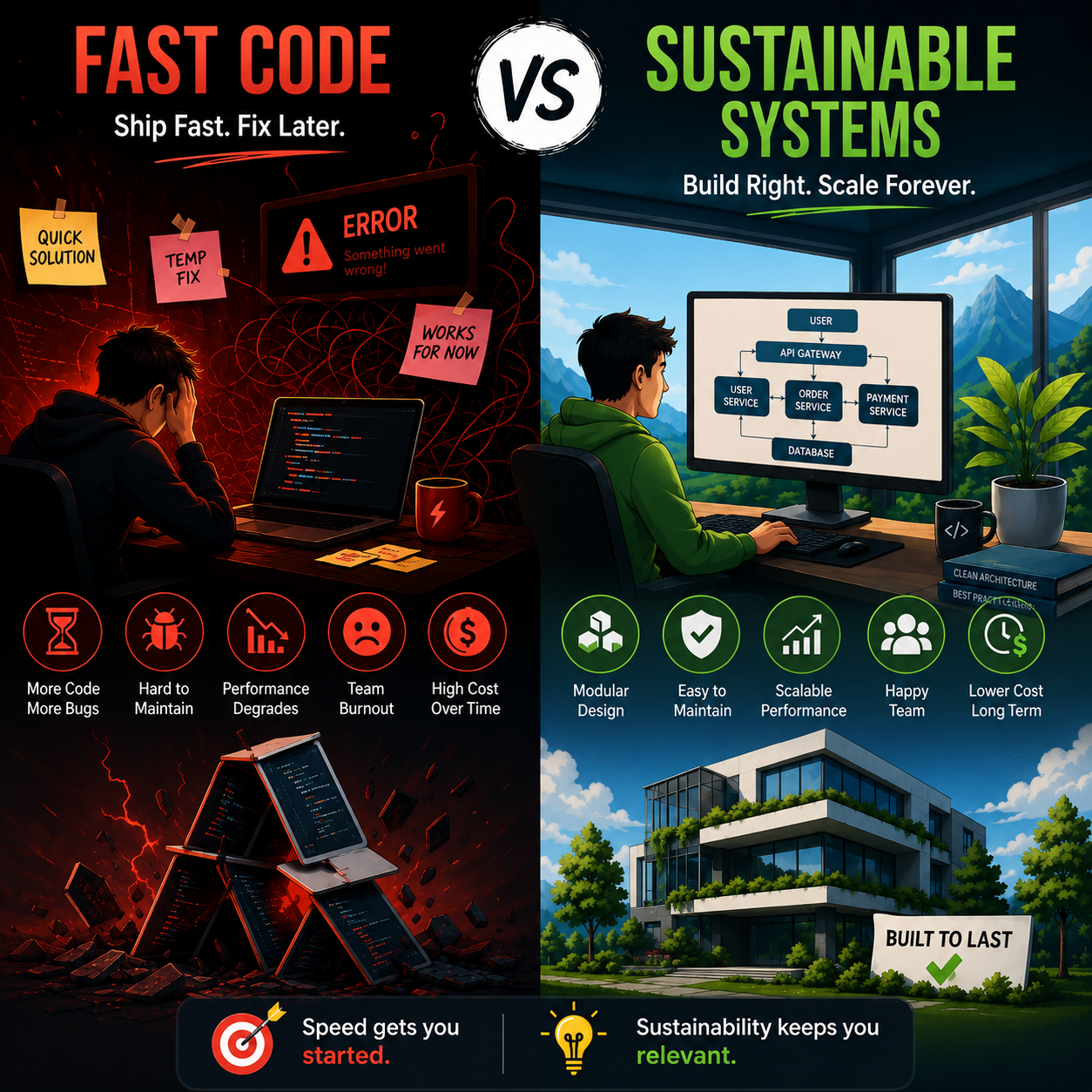
Fast Code vs Sustainable Systems: The Trade-Off Most Developers Ignore
Fast code delivers quickly, but sustainable systems ensure scalability, maintainability, reliability, and long-term success as products grow.